 D-Case Communicator
D-Case Communicator
「合意できているか」を、議論の構造とともに可視化する。 See where agreement stands — right on the structure of the argument.
GSN(Goal Structuring Notation)でシステムの安全性・信頼性の議論を描き、ステークホルダーへのアンケートから合意形成点と確信値を計算するWebアプリケーションです。 A web application for drawing assurance arguments in GSN (Goal Structuring Notation) and computing, from stakeholder surveys, a consensus score and a confidence value for every part of the argument.
課題The problem
「安全だと説明できる」だけでは、合意したことにならない An argument you can present is not yet an argument people agree with
安全性や信頼性の議論は、GSNのような表記法を使えば構造化して書き表せます。しかし実際の現場で問題になるのは、書かれた議論に対して誰が・どこに・どの程度納得しているのかが見えないことです。合意できていない箇所が特定できなければ、議論のどこを補強すればよいかも決まりません。 Safety and dependability arguments can be written down in a structured notation such as GSN. What is usually missing in practice is the other half: who accepts which part of that argument, and how strongly. Without that, there is no way to tell which branch of the argument needs more work.
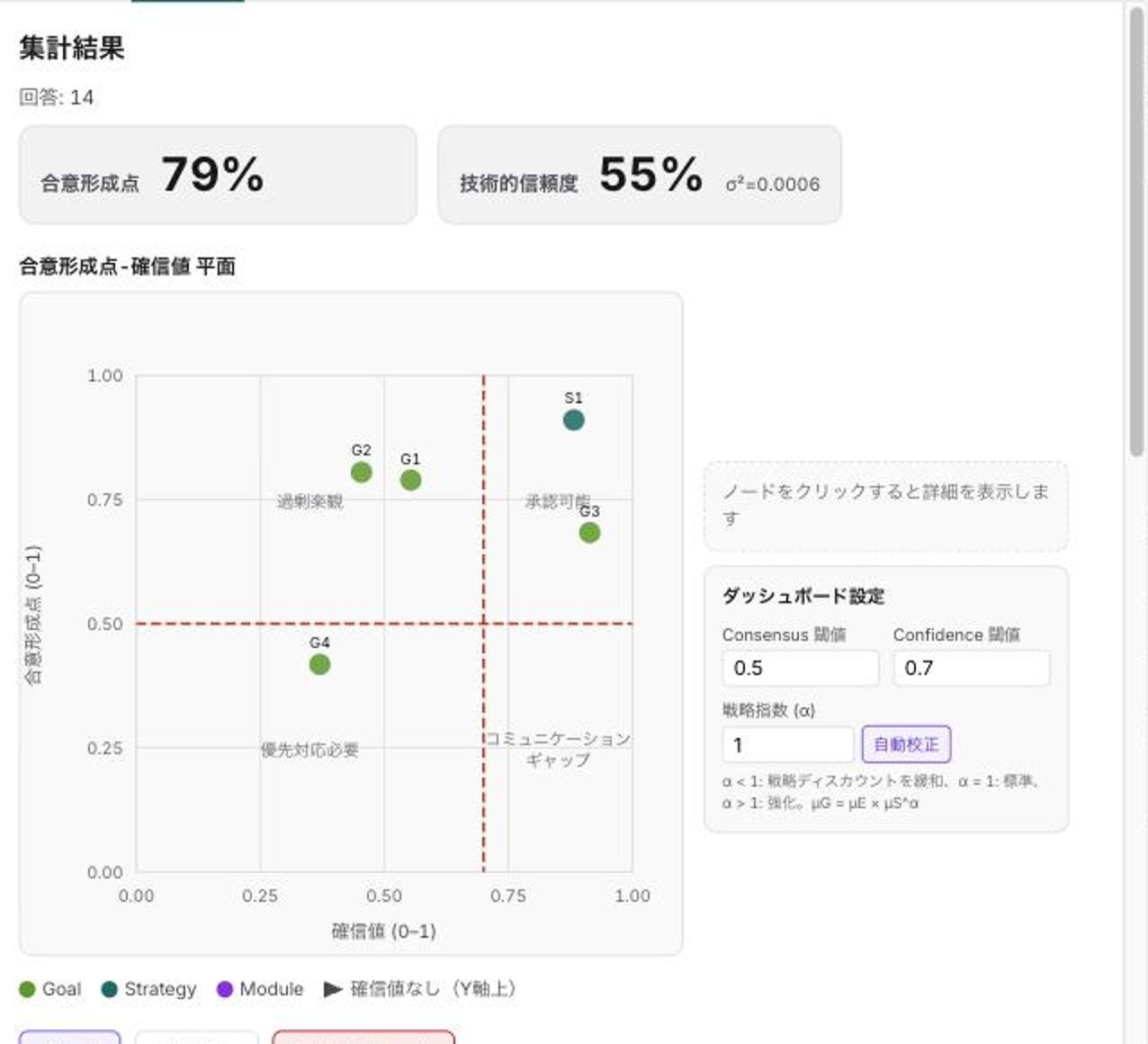
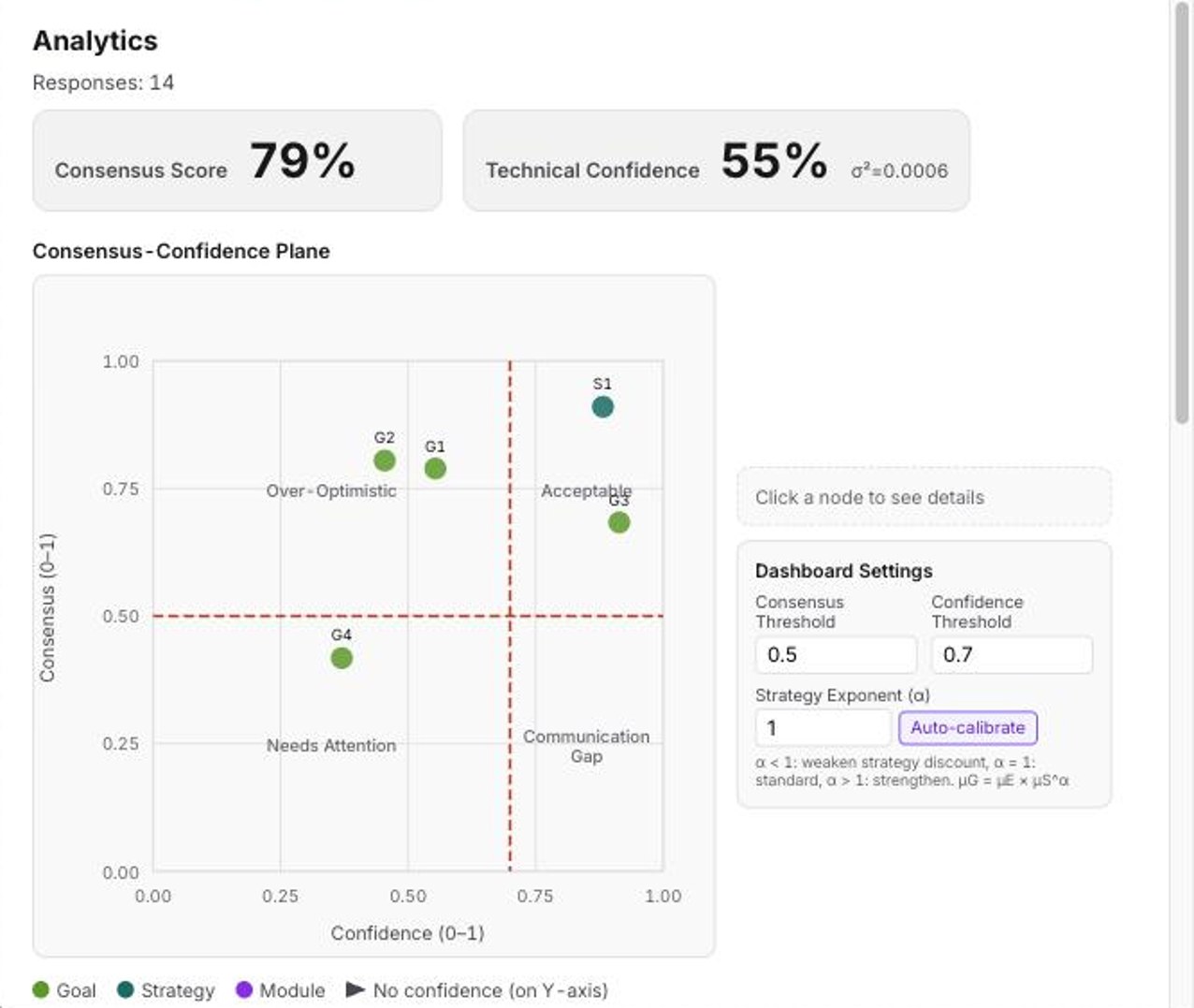
D-Case Communicator は、議論の構造そのものをアンケートの単位として扱います。ゴールや戦略のひとつひとつについて、利用者や事業者などの非専門家からは「納得できるか」を0〜3で、専門家からは「確信が持てるか」を0〜1で集め、GSNの木構造に沿ってボトムアップに集計します。結果はノード単位で、合意形成点と確信値の2軸の平面上に配置されます。 D-Case Communicator turns the argument structure itself into the unit of surveying. For each goal and strategy, non-experts rate agreement on a 0–3 scale and domain experts rate confidence on a 0–1 scale; the scores are then aggregated bottom-up along the GSN tree. Every node lands somewhere on a two-axis plane of consensus and confidence.
使い方Workflow
資料を読み込み、関係者を洗い出し、議論を組み立て、合意を測る From source documents to a measured consensus, in four steps
4つのステップは、そのままツールの画面構成になっています。すでにGSNがある場合は Step 2 から始めることもできます。 The four steps map directly onto the screens of the tool. If you already have a GSN, you can start at step 2.
資料収集Collect source material
仕様書・議事録・分析資料などのPDFや画像をプロジェクトに添付します。AIが内容の説明文を自動生成し、以降の分析の材料になります。 Attach specifications, meeting notes and analysis reports as PDF or images. The AI assistant drafts a description of each document, which later steps draw on.
ステークホルダー分析Stakeholder analysis
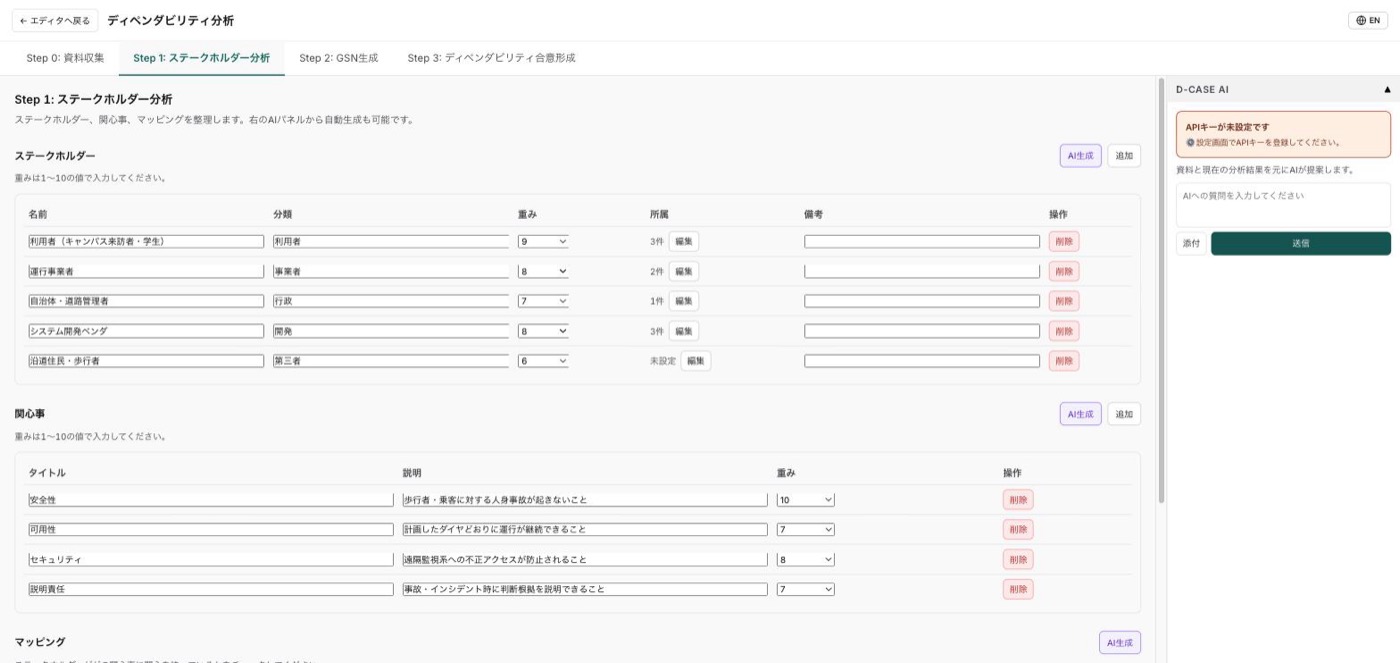
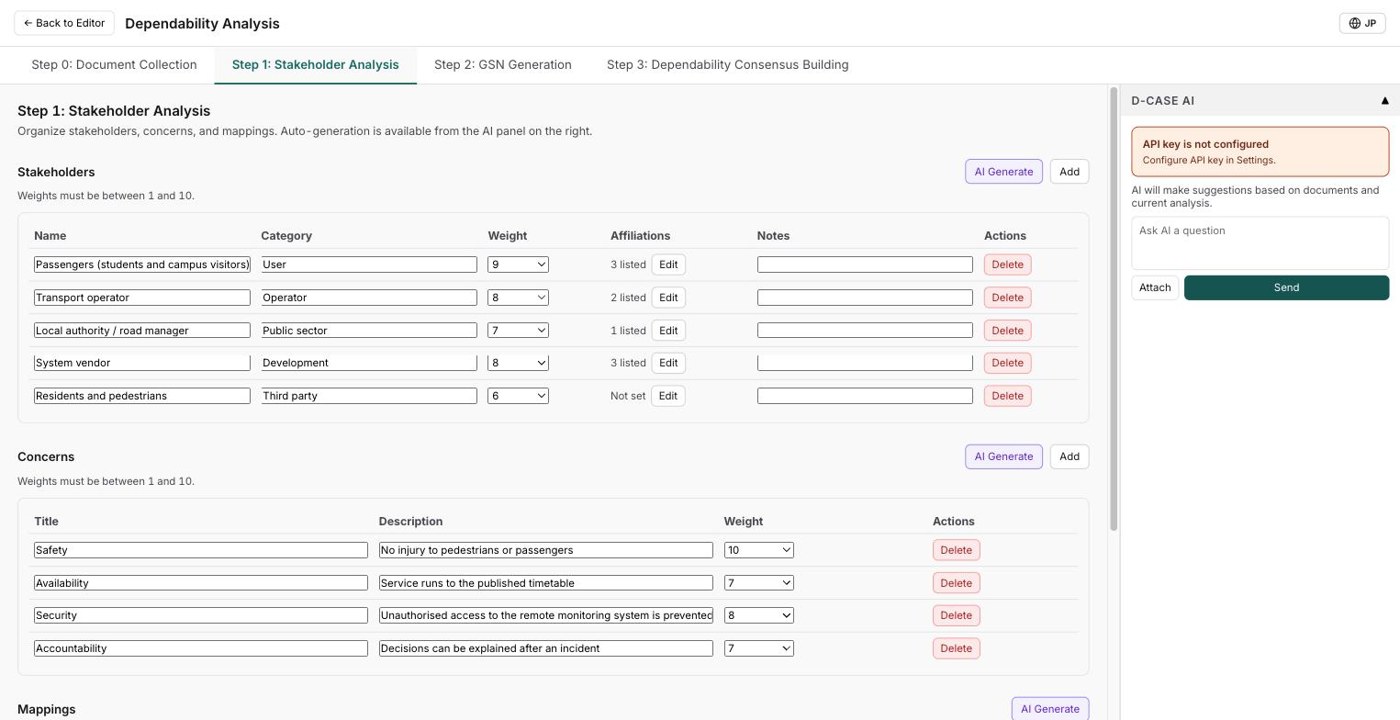
誰が関係者で、それぞれ何を気にしているのか(関心事)を整理し、重みを付けます。ステークホルダー・関心事・対応関係はAIに草案を作らせることもできます。 List who is involved and what each of them cares about, and weight both. Stakeholders, concerns and the mapping between them can be drafted by the AI assistant.
GSNの生成と編集Generate and edit the GSN
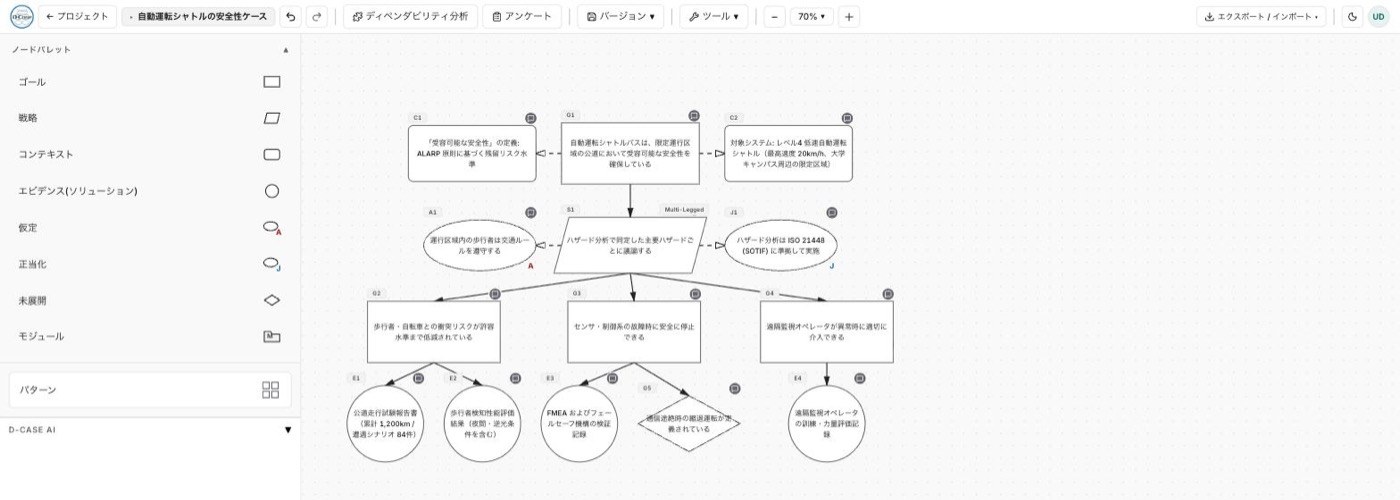
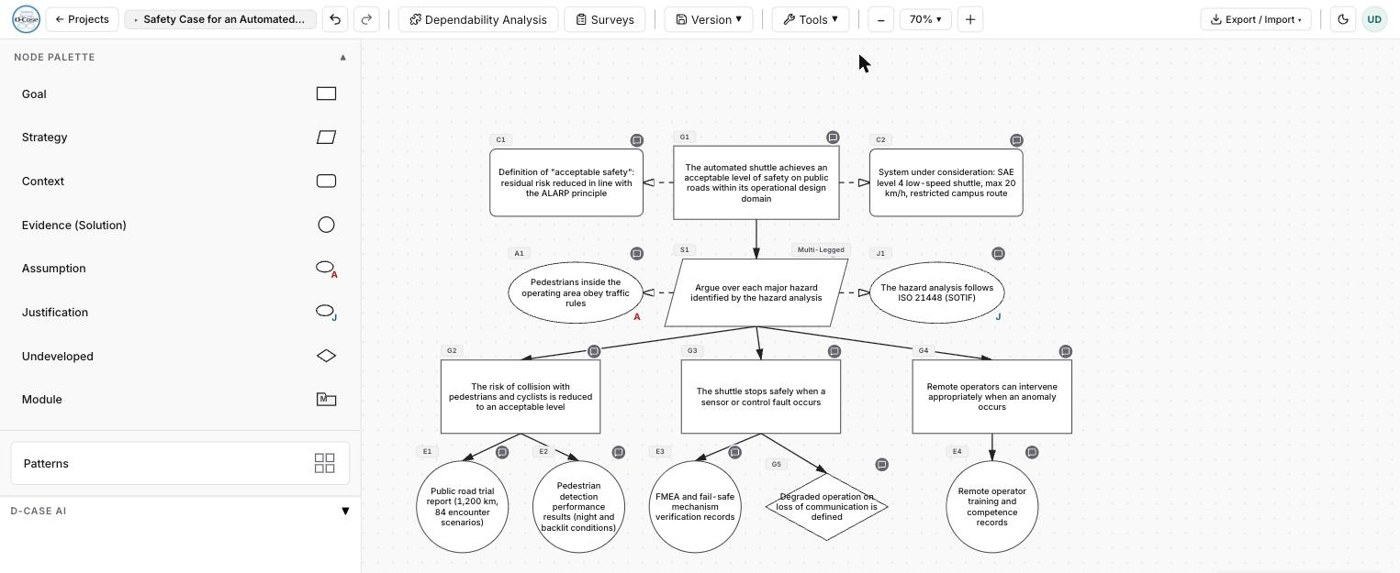
関心事ごとのモジュールを持つGSNを自動生成し、エディタで作り込みます。自動レイアウト、6種類の構造検証、リアルタイム協調編集、コミットと履歴が使えます。 A GSN with one module per concern is generated automatically, then refined in the editor: automatic layout, six structural checks, real-time collaborative editing, commits and history.
アンケートと合意形成Survey and consensus
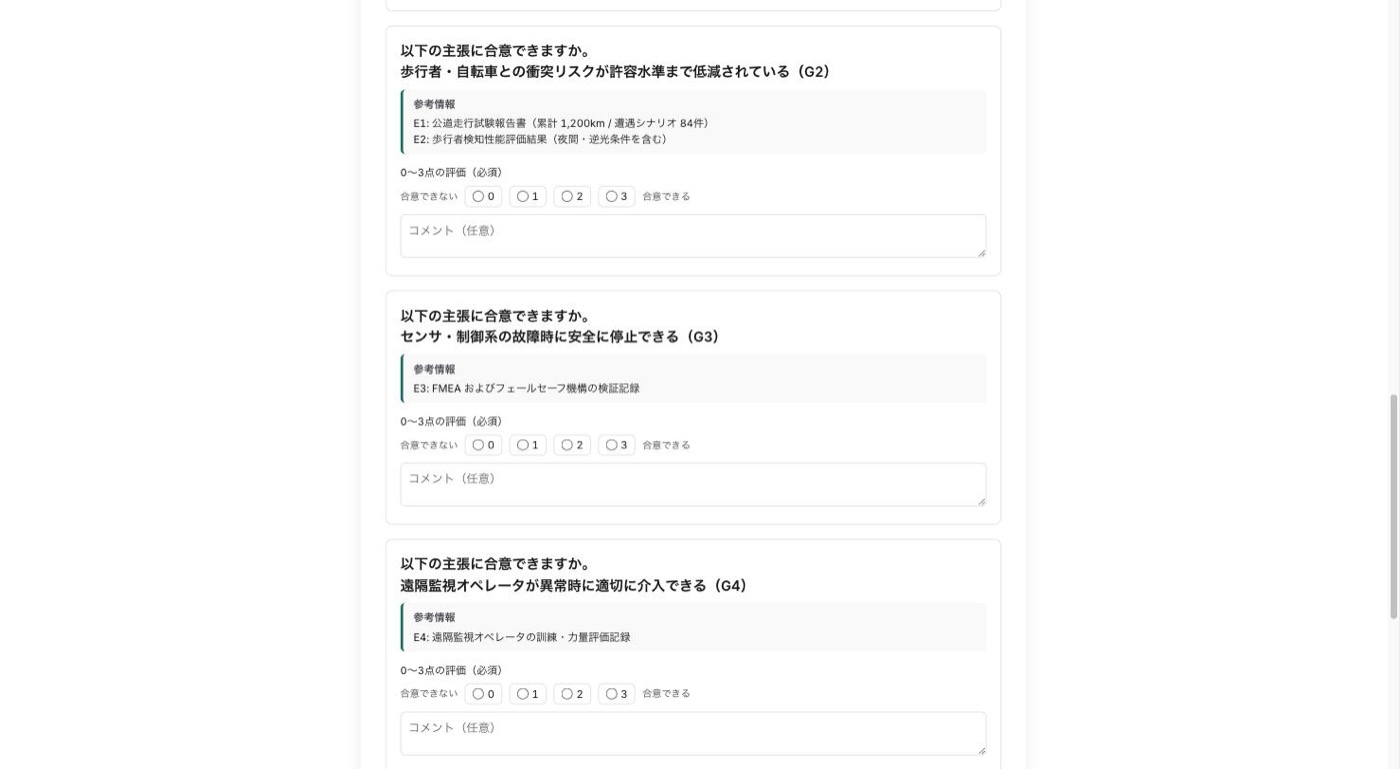
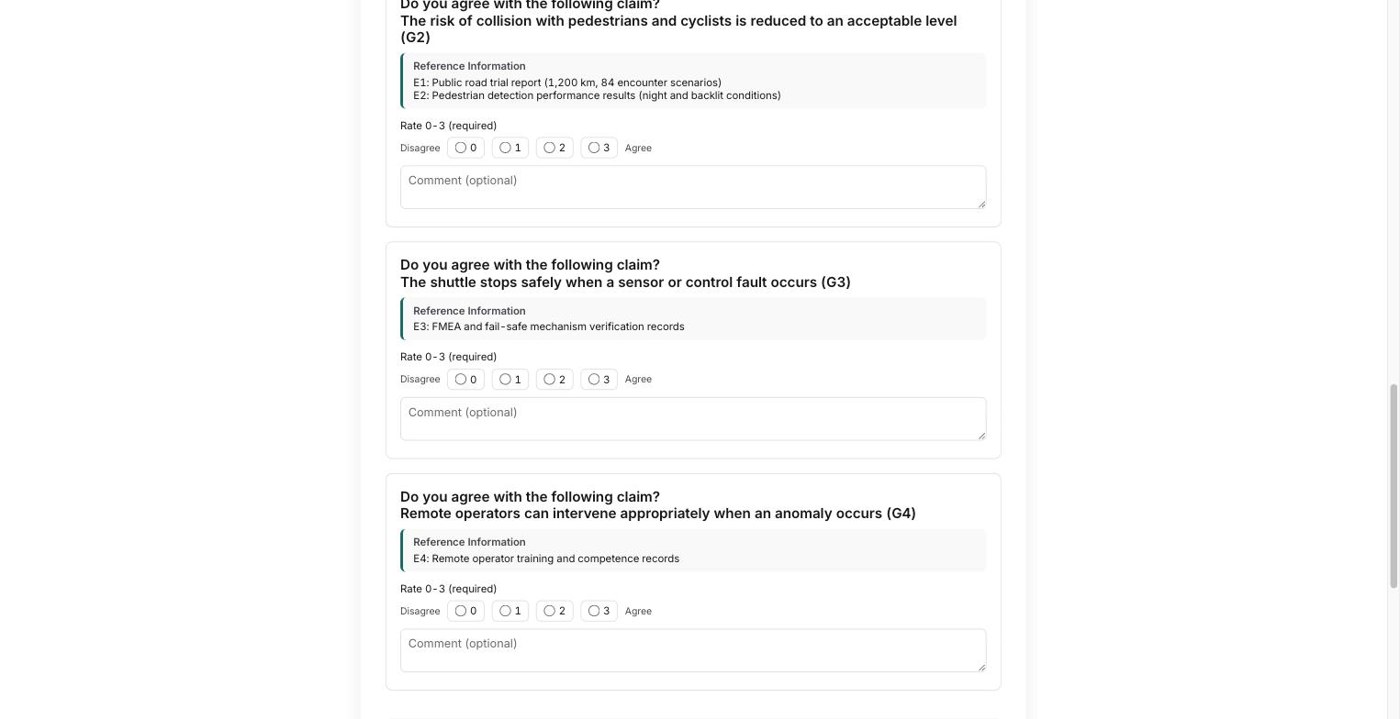
GSNから質問文を自動生成し、非専門家用・専門家用の2つの公開URLで回答を集めます。回答が届くたびに集計と散布図が更新されます。 Questions are generated from the GSN and published at two public URLs — one for non-experts, one for domain experts. The aggregation and the scatter plot update as answers arrive.
機能Features
主な機能 What the tool does
GSN標準準拠のエディタA GSN-conformant editor
Goal / Strategy / Context / Evidence / Assumption / Justification / Undeveloped / Module の8種類のノード。自動レイアウト、ラベル自動採番、6種類の構造検証、PNG・SVG・JSON出力。 Eight node types — goal, strategy, context, evidence, assumption, justification, undeveloped and module. Automatic layout and labelling, six structural checks, and PNG / SVG / JSON export.
リアルタイム協調編集Real-time collaboration
同じ図を複数人で同時に編集できます。他の参加者のカーソルも表示されます。コミット・履歴・ロールバックによるバージョン管理付き。 Several people can edit the same diagram at once, with each other's cursors visible. Versions are managed with commits, history and rollback.
ステークホルダー分析Stakeholder analysis
関係者・関心事・その対応関係と重みを管理し、そこからGSNの骨格を生成します。生成された各モジュールにはステークホルダー情報が引き継がれます。 Manage stakeholders, concerns, their mapping and weights — then generate the skeleton of a GSN from them. Stakeholder information is carried into each generated module.
アンケートSurveys
ゴール・戦略ごとの質問を自動生成。匿名/記名の切替、回答対象とする階層の制御、質問文の一括編集、CSV出力に対応します。 Questions are generated per goal and strategy. Anonymous or named responses, control over how deep in the tree respondents are asked, bulk editing of question text, and CSV export.
合意形成点と確信値の計算Consensus and confidence
木構造に沿った階層集計。戦略ノードの分解タイプ(多脚・AND・OR・1対1)に応じて子ノードの集約方法が切り替わります。 Scores are aggregated hierarchically along the tree, with the aggregation rule chosen by the strategy's decomposition type — multi-legged, conjunctive, disjunctive or one-to-one.
AIアシスタントAI assistant
Claude API と連携し、図の作成・修正、質問文の生成、ステークホルダー草案の作成を対話で行えます。適用前に操作内容をプレビューできます。 Backed by the Claude API: build and revise diagrams, draft question wording and stakeholder lists through conversation. Every proposed edit is previewed before it is applied.
中核となる考え方The core idea
合意形成点 – 確信値 平面 The consensus–confidence plane
非専門家の納得度(合意形成点)と専門家の確信度(確信値)は、別のものです。この2つを別々の軸に取ると、議論のどこに手を入れるべきかが4つの象限として現れます。 How far non-experts accept a claim and how confident experts are in it are two different things. Plotting them on separate axes turns the question "where should we work next?" into four quadrants.
研究背景Research background
合意形成点と確信値の計算モデル How consensus and confidence are computed
D-Case Communicator は、松野研究室におけるアシュアランスケースと合意形成の研究を実装したものです。合意形成点はステークホルダーの重みを反映してGSNの木構造に沿って集約され、確信値は専門家回答のばらつきを考慮して集約されます。 D-Case Communicator implements the lab's work on assurance cases and consensus building. Consensus scores are aggregated along the GSN tree with stakeholder weights applied; confidence values are aggregated taking the spread of expert responses into account.
合意形成点の階層的定義Hierarchical consensus score
- ステークホルダーの重みを反映した加重集計Weighted aggregation reflecting stakeholder weights
- GSNの木構造に沿ったボトムアップ計算Bottom-up computation along the GSN tree
- 関心事の重みによるトップゴールの集約Aggregation of the top goal by concern weights
確信値の集約と分解タイプConfidence aggregation and decomposition types
- 逆分散重み付け(IVW)による多脚議論の集約Inverse-variance weighting for multi-legged arguments
- AND(幾何平均)/OR(最大値)/1対1(パススルー)Conjunctive (geometric mean), disjunctive (max), one-to-one (pass-through)
- トップゴールへの直接評価は独立に集計Direct assessment of the top goal is tracked separately
関連論文Publications
- Yutaka Matsuno, Michio Hayashi, Tomoyuki Tsuchiya. 「Consensus Building in Level 4 Automated Driving Field Trials Through Assurance Cases」. SAFECOMP 2025, pp. 33–47.
-
Yutaka Matsuno, Michio Hayashi, Tomoyuki Tsuchiya.
「Strategy-Aware Confidence Assessment with Stakeholder Consensus for Level 4 Automated Driving Assurance Cases」.
発表予定Upcoming
SASSUR 2026(第13回 International Workshop on Next Generation of System Assurance Approaches for Critical Systems、SAFECOMP 2026 併設)、2026年9月22日・スペイン バレンシア。 SASSUR 2026 — 13th International Workshop on Next Generation of System Assurance Approaches for Critical Systems, co-located with SAFECOMP 2026, 22 September 2026, Valencia, Spain.
sites.google.com/view/sassur2026
利用と技術情報Access and technical details
使ってみる Try it
公開インスタンスをブラウザから利用できます。研究・教育目的での利用や共同研究のご相談は、下記の連絡先までお願いします。 A public instance runs in the browser. For use in research or teaching, or to discuss collaboration, please get in touch using the contact details below.
| 公開インスタンスPublic instance | d-case.matsulab.org |
|---|---|
| 対応言語Languages | 日本語 / English(画面・アンケートとも切替可能)Japanese / English, for both the editor and the surveys |
| フロントエンドFrontend | React 19 + TypeScript + Vite(SVG描画) (SVG rendering) |
| バックエンドBackend | Express 5 + Prisma + SQLite + Socket.IO |